

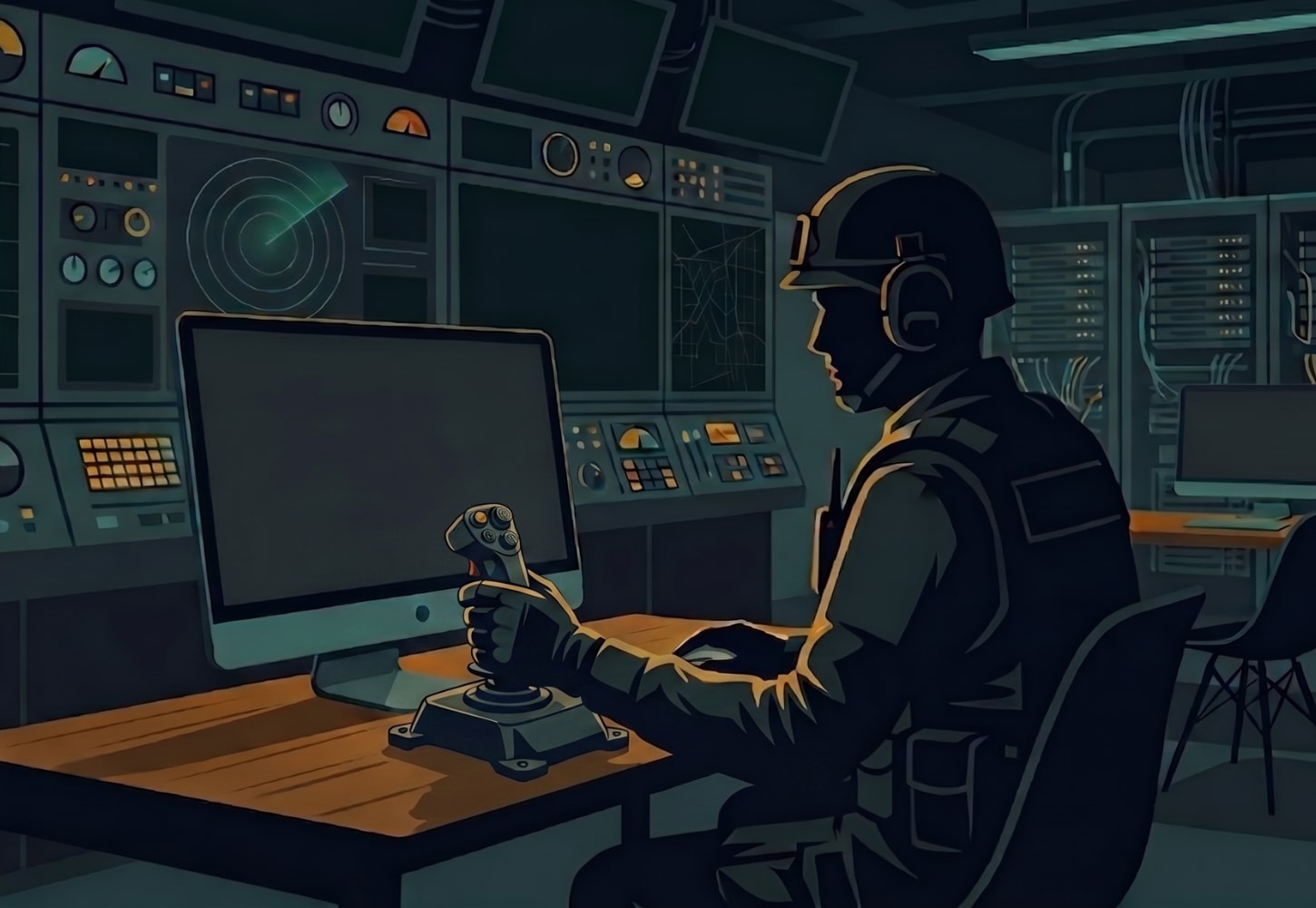
The British Armed Forces’ ability to deliver precision fires and effects is being brought under the integration of all domains, sensors, assets, and weapon systems for rapid decision-making and execution of operations. This new battlespace requirement carries significant new training objectives for the use of Artificial Intelligence (AI)-enabled systems.
Training objective 1: Inculcate cooperation
The first training objective, therefore, of the approach to operational design is cooperation. The ‘tribal’ loyalties of the British Armed Forces have their place in creating identity, and thereby foster cohesion under conditions of great stress. However, in the modern battlespace, there is no room for service or ‘cap badge’ preferences. Every asset, every platform, and every call sign must focus entirely on the mission. Misplaced loyalty to an organisation could cost time and lives.
Training objective 2: Knowledge of friendly forces and the enemy
In the conditions of all-domain operations, where time is limited, it is vital that personnel intimately know the platforms and capabilities of their own forces, their allies, and their adversaries. Failure to recognise and differentiate the units of the enemy (which will be trying to conceal themselves, their movements, and their intentions), to spot anomalies, and to know what capabilities allied forces possess could cost the British Armed Forces dearly. Knowledge of these elements gives significant operational advantage.
Training objective 3: Prepare personnel for AI-enabled targeting and the application of the Law of Armed Conflict (LOAC)
It is clear that the British Armed Forces need to be able to integrate AI into targeting workflows. AI has proven its value in Intelligence, Surveillance, and Reconnaissance (ISR) data processing, decision support, and the operation of autonomous, uncrewed systems. The bringing together of assets for a task is exemplified in experiments such as the use of the ‘uber platform’ to request assets, see how far away they are (and therefore what timings are available), and to know when they have been delivered. Battle Damage Assessment (BDA) is a component that can be fed into the same system, ready for further tasking onto the target if necessary.
AI only provides the options and selections of targets. For the near term, human operators and commanders will need to decide when to release lethal ordnance. However, in the event of a major war against Russia, Iran, or the People’s Republic of China (PRC), it is unlikely that peacetime rules of engagement will survive contact for long. The pattern of past major wars suggests that, at best, the most egregious levels of destruction could be minimised, but recent armed conflicts in Ukraine and the Middle East suggest that unrestrained and less discriminate targeting will occur in a dynamic, escalating situation.
Training objective 4: Training for learning to adapt under time pressure
Time is the most limited resource in war, and AI enhancements to the targeting process mean that survival will depend on the ability to act, react, and adapt faster than adversaries. Instead of content-learning, AI-enabled war suggests that British personnel should train for adaptation. They should focus on how to learn new things, the skills of adaptation, and rehearse with speed tests and improvisation. AI enables scaling; to cascade effects, the processing of much larger volumes of data to give a wider field of view, and acceleration in decision-making.
Training objective 5: Decisions and leadership of AI-enabled teams
Leaders require training in the handling of AI agents in the battlespace, and of the human teams which support the execution of operations. One of the critical aspects of AI-enabled conflict is that senior commanders will need to devolve tasking to junior levels because of the speed of operations and the sheer scale of the battlespace. Strategic assets will come under their direct command in rear zones (homeland defence will be the direct responsibility of national governments and their military commanders), while forward-deployed elements will be autonomous.
For senior commanders, the greatest challenge will be feeding assets, primarily munitions, into the forward and deep battlespace. For junior commanders, there will be responsibility for much greater areas and volumes of resources than in the past. Training for this new requirement can build on older forms of Command and Control (C2), such as mission command, but will need to be rehearsed in simulations.
Some threats can be managed entirely by AI, where there is no ambiguity about the validity of the targeting. In some areas, such as dense urban areas populated by civilians or where maritime resources for neutral actors are concerned, greater targeting discernment will be necessary. By practising zooming into the AI-enabled detail, rapid decisions can be made and damage assessed while overall situational awareness is maintained.
Decision-makers will be able to rehearse on simulators, with AI offering immediate real-time feedback. With AI learning directly from each mission rehearsal, and by gradually increasing levels of difficulty and complexity, command teams can become more experienced in a variety of scenarios.
AI enablement will greatly assist in identifying the adversary, fixing and targeting it, offering engagement options, and assisting in the delivery of precision effects before making assessments of the effect. AI has the ability to learn from each of these tasks in action, and improve its data range and option fidelity with each encounter. This improves the assessment process, saving time and munitions as well as bringing greater clarity to the commander’s decision support. Moreover, this learning can be passed on and edited by training teams.
Training objective 6: Managing logistics of autonomous systems
Incorporating AI into the battlespace is about optimising the targeting, delivering effects rapidly with precision, and ensuring the continuous flow of assets to and from the battlespace to maintain operational tempo. In all domain operations, accelerating sensor-to-shooter kill chains, reducing the human operators’ cognitive burden, improving decision-making in a stressful environment, and making sure that the right resources arrive in good time in sufficient volume are critical. AI will seek the most efficient solutions, and can greatly assist in the delivery of combat supplies.
Like all AI, military AI requires the development of specialised agents to ensure that the practices and vocabulary specific to logistics in combat are understood. Simulations and large-scale exercises are vital for the training data needed, and all exercises and simulations require immediate deployment of AI tools for machine learning. In addition, instruction in the management of combat logistics using AI is essential.
Recommendations
It is recommended that all six training objectives are implemented immediately. The speed of AI development over the next five years suggests that an armed force unfamiliar with the use of AI in its battlespace management will fail. It is urgent that training is developed without delay in order to equip all personnel with the skills they will need in near-term conflicts.
Dr Robert Johnson is Director of the Oxford Strategy, Statecraft, and Technology (Changing Character of War) Centre and an Honorary Fellow at the Council on Geostrategy. He is also a Senior Research Fellow at Pembroke College, University of Oxford, and a Professor at the Norwegian Defence University Staff College. Prior to this, he was the first Director of the Office of Net Assessment and Challenge in the Ministry of Defence.
This article is published in partnership with Capita Plc.
To stay up to date with The Broadside, please subscribe or pledge your support!
What do you think about this article? Why not leave a comment below?