

This piece was written in April 2025 for the First Sea Lord’s Essay Competition 2025, and was awarded runner up by the judging panel.
This analysis assumes that the United Kingdom (UK) must defend the North Atlantic alone; that there is no defence or joint operations to rely on, and that Britain must defend against a strategic threat by itself. In this case, the plausible threat in the Atlantic will be identified as Russia’s Northern Fleet, with concerns focused on submarine routes and uncrewed system warfare.
Due to the limited operational capacity of the Royal Navy in an alone scenario, the Greenland-Iceland-UK (GIUK) gap is key to denial and should be reinforced. Therefore, a sovereign maritime strategy which focuses on three pillars would be recommended: reactivation of Scapa Flow as a key anchorage, a development of a resilient drone-commanding battleship and deployment of semi-autonomous systems across the GIUK gap.
Strategic context
Russia’s most viable naval threat vector to Britain is through the GIUK gap and the Norwegian Sea. Therefore, the Royal Navy’s first line of defence is to be able to enforce containment along this vector. In this scenario, it is assumed that the Baltic Sea is contested, and that the Black Sea Fleet remains confined and degraded from the conflict in Ukraine.
However, if this is not the case, it is viable to extend the line to the English Channel, and use assets in Gibraltar to continue an area of denial. It is also worth noting that Canada would likely block the use of the Labrador Sea, even in an ‘alone’ scenario, due to sovereignty of borders. Therefore, the GIUK gap and Norwegian Sea approaches form the most critical zone for UK defence. Denial would be the most operationally effective option.
Recommendation 1: Reactivate Scapa Flow
Scapa Flow enables a deepwater anchorage to the north of the British Isles. Coupled with its historical effectiveness as a naval base, it creates a uniquely defensible bastion, which would be a key anchorage for the Royal Navy in any northern defence.
The proximity of Scapa Flow would serve as a key home base and linchpin in the area denial plan. Furthermore, this would be a cost-effective option due to previous development of the port, enabling the Royal Navy to project power and enforce area denial within a short time period.
The reactivation of a large northern anchorage is key for logistics, surveillance and safe mooring for the Royal Navy. Without its redevelopment, there is a large gap in defence of not only the Atlantic, but the British Isles themselves. If the UK is to stand alone, this reactivation will be key to protecting British interests and keeping the Royal Navy strong in the north due to close localised supply, which adversaries are not afforded.
A fast-track redevelopment policy, with swift implementation of Anti-Submarine Warfare (ASW) nets and development of the modern infrastructure is what the Royal Navy requires to be formidable in the north.
Recommendation 2: The ‘Dominion’ class ship
To reconcile issues in recruitment and naval capacity the UK would have in an ‘alone’ scenario, a new class of ship should be implemented: the ‘Dominion’ class, based on designs of USS South Dakota or a similar vessel. A modernised battleship equipped for saturation from missiles, or Underwater Uncrewed Vehicle (UUV), or Uncrewed Surface Vehicle (USV) attacks, is now needed in modern battles.
This saturation is shown in the USS South Dakota report. To ensure its ability to stay afloat, the Dominion class would be equipped with its own drone, USV and UUV launch and recovery capabilities, making it a formidable sea fortress. Based on survivability data and reports from Ukraine, missiles, USVs and UUVs pose a contemporary problem to modern navies, with the sinking of the Russian Navy’s Moskva ‘to have been preceded by days of attacks using UAVs [Uncrewed Aerial Vehicles]’ – drones – before missile strikes.
Therefore, ships need to demonstrate new survivability through robust armouring and smart modular internal design. During the naval battle of Guadalcanal in the Second World War, USS South Dakota not only endured high-intensity battles from bombardment but returned to the fight, providing support and firepower. In the age of uncrewed warfare, the ability to absorb damage and remain in the fight will be key to future naval engagements, making redundancy key due to high-damage scenarios becoming likely.
With a citadel design, a modular ship means high survivability and room for the ability to be a nerve centre for the Royal Navy. This ship would focus on command presence, and act as a drone and communications hub, meaning few are needed. Its high survivability would also meet the Ministry of Defence’s (MOD) Defence Maritime Regulations, specifically 606, 307 and 604-605.
Recommendation 3: Semi-autonomous systems
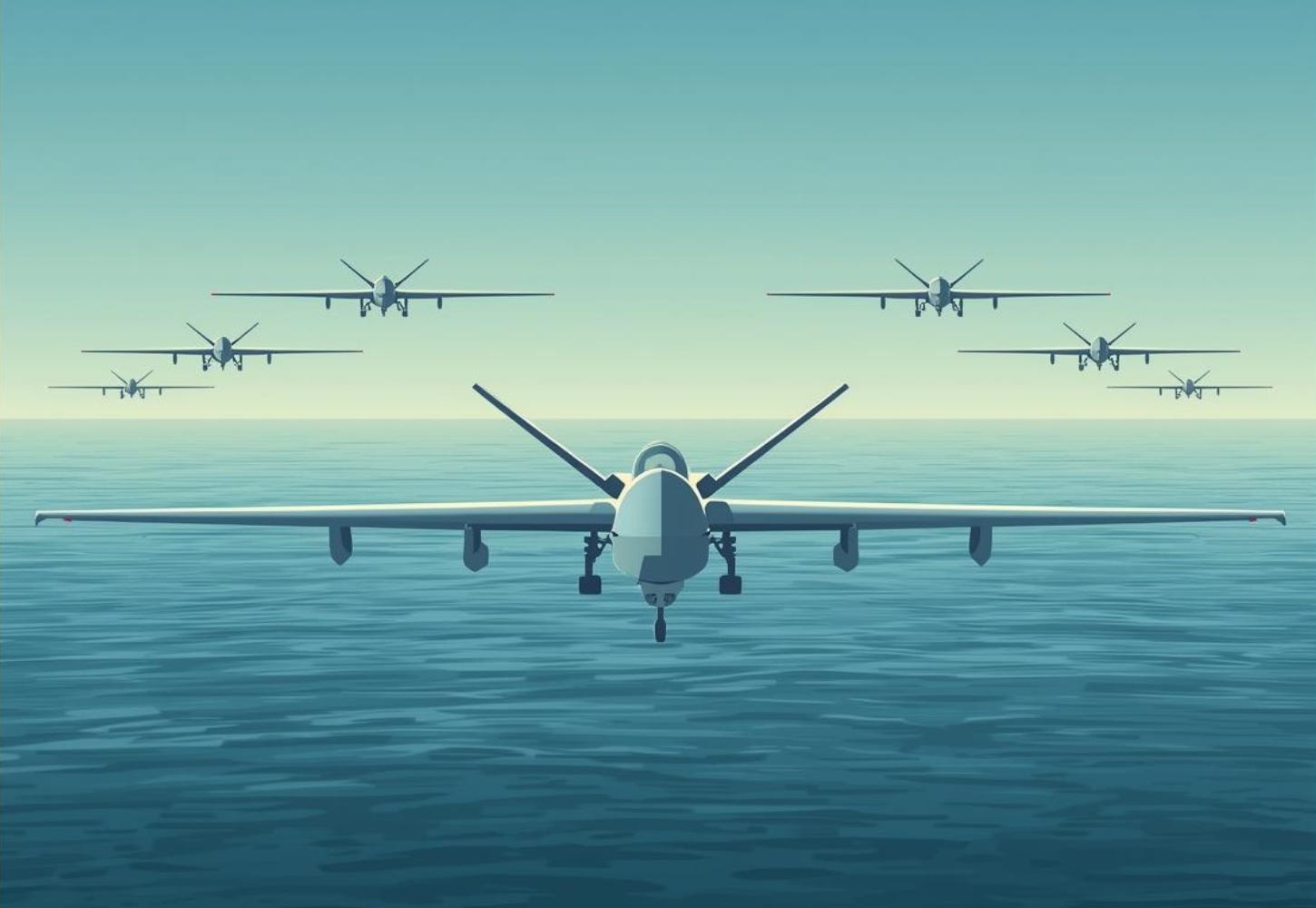
Britain should improve its semi-autonomous systems to enable uncrewed patrol and sensor nets to be deployed from Scapa Flow and Dominion class ships to the GIUK gap and Norwegian Sea. Augmenting the Royal Navy with a ‘mothership’ which would have the ability to deploy, retrieve and repair semi-autonomous systems such as Remus UUVs or MQ-9A Reapers, would reshape naval warfare in the UK’s favour, ensuring conscription is not needed to maintain high operational capability.
The Dominion class would monitor submarine and ship movements via semi-autonomous systems, relaying real-time data to Scapa Flow and other Dominion class ships, creating an effective sustained armed presence without overstretching the Royal Navy’s crewed fleet and making area denial feasible. Furthermore, this new drone-ship class would be consistent with the MOD’s Defence Drone Strategy and ideas of growing autonomous fleets.
Conclusion
In conclusion, even in a world of allies or adversaries, Britain must hold the GIUK gap-Norwegian Sea corridor. However, geography and technology give the UK the ability to develop an edge if it invests wisely. To defend the North Atlantic alone, Britain should look beyond traditional manpower and fleet ideas to embrace a new doctrine in naval innovation.
Harry Dove is an International Strategy and Policy Desk Officer at the Ministry of Defence, working to realise the potential of NATO, AUKUS and other international innovation activities. He holds an MA in International Relations and Affairs from King’s College London.
To stay up to date with The Broadside, please subscribe or pledge your support!
What do you think about this article? Why not leave a comment below?
Does the UK have air defense assets to protect Scapa Flow? Reference: D. Haynes’ Wargame (https://www.youtube.com/playlist?list=PLG8IrydigQfeg0mRrlniT36ia-tMD_vzb)
Nice to see someone talking about the obvious need to reactivate Scapa. As some of the other comments mention, the RAF will have to re-fortify the Shetlands again to protect scapa properly. FOB’ing fighters from Lossie to wick/sumburgh will help, but significant GBAD and coastal defences will be required in Shetland, Orkney and mainland Scotland to defend Scapa. Coastal defences are really important here as well. Mixed coastal anti surface and anti-air will permit MPA/H a safer entry to the battle zone as well.