

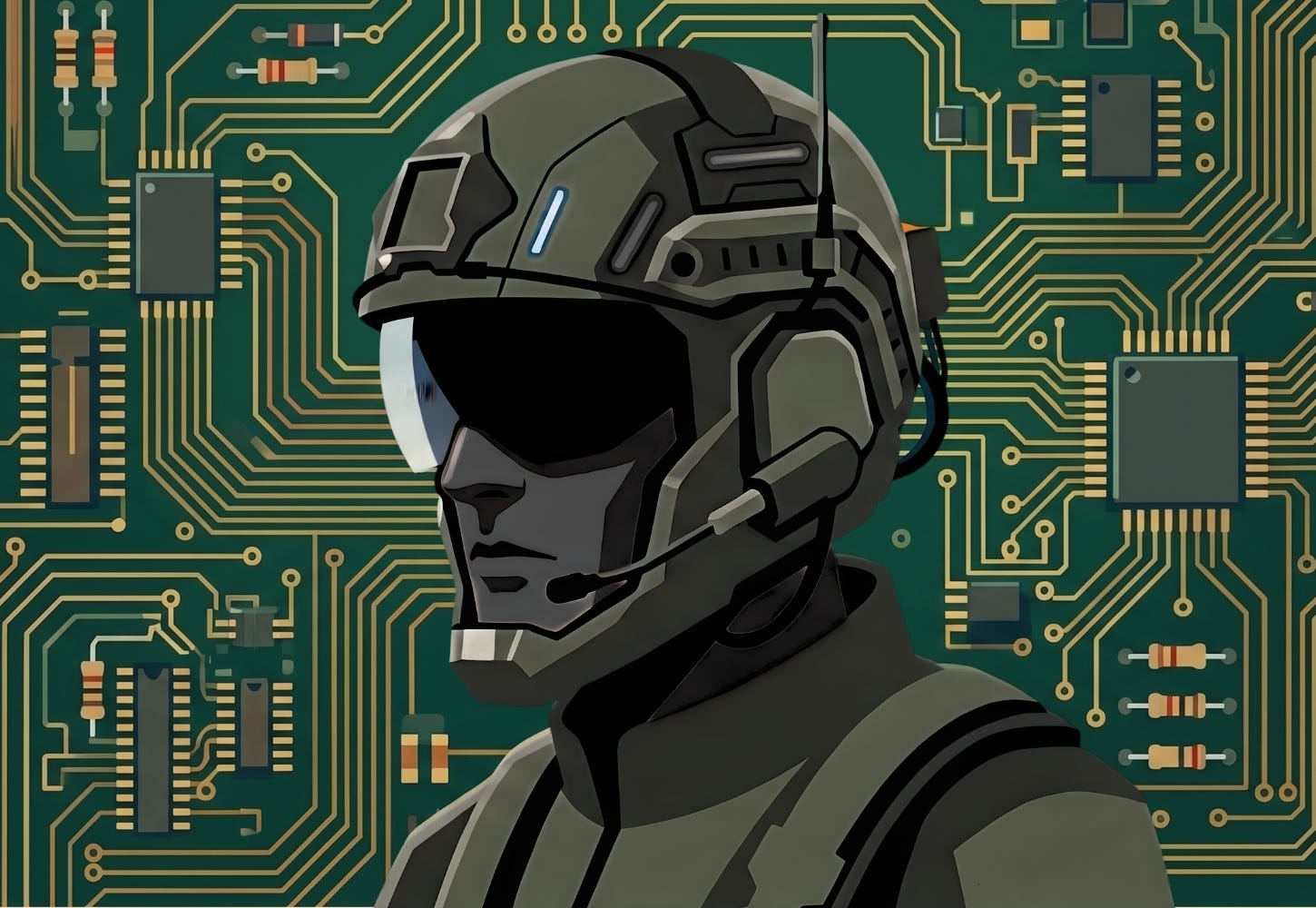
Imagine the following scenario:
The pilot officer was concerned that, in just 60 seconds, he had lost 50% of his drone swarm platforms. Although the communicative integrity of the swarm was still intact, this loss rate was unsustainable for more than another minute or two. The AI-command system recommended two courses of action:
Continue, in order to absorb the potentially limited fires available to the enemy; or
Break left and hug the ground to ensure as many of the drones survived as possible at a very low altitude. The AI had calculated that losses due to obstacles would be in the region of 10.5% against the ‘sure thing’ loss of around 89% at the present bearing and speeds.
The human operator did not hesitate, but put the swarm into a ground-hugging mode. Ground fires inflicted more attrition, but the swarm’s remnants passed through the kill zone and headed rapidly towards their target field. At the pre-appointed junction, the swarm split into individual elements and dived onto an array of enemy platforms – dismounted troops, vehicles, a supply ship, a drone container vehicle, and, ironically, an air defence battery.
Meanwhile, a few miles away, a Royal Navy warship was releasing its second wave of drone swarms – a cloud of around 2,000 miniature platforms – while simultaneously shooting down incoming missiles and implementing its deception measures; an Electronic Warfare (EW)-chromatic interference ‘shield’ which made it seem that the vessel was several hundred metres north of its actual location. Several hostile missiles plunged harmlessly into the sea, and AI-enabled Intelligence, Surveillance, and Reconnaissance (ISR) assets, high above the ship, reported the grid was once again ‘green’, at least for the next three minutes.
Into this window of opportunity, the commander could assess the threat, and use his AI array to scan for additional targets, including the source of the incoming missiles. AI had already tracked the trajectory and worked back along the flight path to discern the likely launch points, even for moving platforms. Identified, the AI agent ‘goalkeeper’ reported that there were no innocent elements within the kill zone.
As a result, it had not waited for any human intervention – it was pre-programmed to destroy any threats where the targeting was unambiguous. The commander, relieved that the Self-Defence (SD) system was functioning as expected, was free to search for targets in greater depth.
Heading into view were four autonomous maritime supply pods, nicknamed ‘whales’ by the six-strong crew of the warship. They were initiated automatically when weapon stocks on board reached a certain level. The AI calculated water, munitions, rations, fuel, and all manner of crew needs on a real-time basis, and dispatched a steady loop of uncrewed and fast-moving boats to conduct automated resupply and reloading at sea. A large air drone touched down on the rear deck too, with a specific air defence payload that was needed more urgently.
The commander reflected that in 1842, his ancestors had also defeated the Chinese navy. The technological edge of the Royal Navy then, as now, had been the single most important factor in the United Kingdom’s (UK) latest naval victory.
How does AI impact combat in the 2020s and 2030s, and how should the British Armed Forces train for it as an ‘in contact’ phenomenon?
Advancements in AI will reshape almost every aspect of war, and the British Armed Forces will have to learn how to adapt ‘in contact’ as well as preparing for the potential ‘first contact’ between AI systems. Today, AI is already embedded within smart sensors and some autonomous platforms, but in the near future, AI will drive weapon systems; enhance real-time decision-making; govern logistics; conduct defensive and offensive cyber-operations; and offer augmentation to personnel in terms of situational awareness, nearby weapons, and counter-targeting. What follows are eight applications for ‘in contact’ consideration.
Application 1: Autonomous weapon systems
AI-guided loitering munitions and swarming drones will execute precision strikes with minimal human input at the outbreak of war, but within weeks, fully independent sensor-shooter areas will be created – initially geographically prescribed and then increasingly as thematic matters, such as counter-ambush defence.
Uncrewed ground and maritime vehicles will navigate complex terrain or very long distances at sea, using satellite or loitering Uncrewed Aerial Vehicle (UAV) precision, navigation, and timing. They will identify threats and engage adversaries under AI control. After initial exchanges, rapid adaptation will be required to overcome physical obstacles, electronic counter-measures, and adjustments to their sensing and shooting capabilities. An evolution of systems will require agile engineering development, rapid experimentation, and equally speedy deployment.
Machine learning models will continuously refine targeting accuracy, reducing collateral damage and reaction times, and human operators will need to utilise a generic training model and then adapt to new systems rapidly, adding to the feedback loop between targeting; countering deception measures; assessing payload effects and damage assessment; and the speed of delivery.
Application 2: Enhanced ISR
AI will fuse data from satellites, signals intercepts, UAVs and ground sensors into unified battlespace pictures almost instantaneously. In contact, some systems will quickly become redundant. On the whole, visibility and slowness will be the death knell of certain systems. Personnel will have to become used to acting in dispersed environments, with mutually supporting area denial assets – as independent call signs – using AI to enable their survival against detection and their flow of munitions and logistics.
Computer vision and deep-learning algorithms will highlight enemy movements, concealed assets and their logistic hubs in real time, enabling deep strike capabilities as well as tactical actions.
Quantum-accelerated processing on AI-enabled drones promises near-instant analysis of vast sensor streams, vastly outpacing current systems, while AI will filter data into meaningful targets and prioritise them in terms of engagement and payloads. Human training will need to prepare for this ISR environment, knowing when to intervene and when to permit AI to discern and strike. Speed will be of the essence.
Application 3: Decision-making and Command and Control (C2)
Agentic AI ‘assistants’ in command posts, or on the bridge of a combat vessel, will generate courses of action, run multi-domain simulations, and help commanders weigh risks and opportunities. Predictive analytics will anticipate adversary manoeuvres hours and even days in advance, enabling proactive posture adjustments. This will be vital when the UK’s own platforms are more limited in number, and losses have been taken.
AI-driven ‘digital twins’ of theatres of operation will allow leaders to rehearse scenarios and optimise force deployment before committing troops, in a form of real-time wargaming.
Application 4: Cyber EW and combat communications
Defensive AI will detect and block sophisticated intrusions by discerning anomalous network patterns faster than human analysts, while offensive AI tools will autonomously probe adversary networks, craft bespoke malware, and conduct denial-of-service campaigns with adaptive strategies in great depth.
AI agents will constantly search vast data fields for anomalies and ‘giveaways’, update the deployed ‘field AIs’, and locate opportunities. Electromagnetic Spectrum (EMS) management AI can dynamically jam or deceive enemy radars and communications while preserving friendly links, hopping channels and bursting communications in miniaturised but dense packets.
Application 5: Logistics, maintenance, and supply
AI will predict equipment failures via pre-installed sensor-derived prognostics, scheduling maintenance just before most breakdowns occur and thereby maximising readiness and reducing repair burdens. However, battlespace damage will be discerned rapidly using onboard sensors, and component parts scanned to see if systems can be rendered operative and battle-ready, or whether they are fit only for cannibalisation.
Autonomous convoys or dispersed individual Uncrewed Maritime Systems (UMS) guided by AI pathfinding will reduce exposure of supply lines to surprise attack and air threat. Machine-learning optimisers will balance fuel, munitions, stores, water, and rations distribution across dispersed units for leaner support chains.
Application 6: Personnel augmentation and medical support
Embedded AI in helmets, Heads Out Displays (HODs), and exoskeletons will offer real-time hazard alerts, target acquisition cues, and load-carriage assistance. Wearable biosensors feeding AI models will monitor combat stress and health, triggering medical evacuation (medevac) or rest cycles when vital signs indicate risk. Haptics will offer warnings of threats, and in-built alarms will warn personnel when resting of inbound threats. Robotic combat medics will traverse contested terrain to administer basic life-saving care under AI guidance, while serious cases will benefit from rear area senior professional medical operatives via Virtual Reality (VR) headsets.
Application 7: ‘In contact’ adaptation lessons process and planning
AI will review situations and effects in real time, and feed back to those in contact on what has been discerned in enemy patterns of behaviour. AI-driven simulations will conduct mission rehearsals in vast multi-domain conflicts, drawing on real-time data to stress test plans and doctrines, identify the most likely options to succeed and brief command teams on the options available.
Application 8: Ethical and legal focus
The acceleration of operational tempo by AI can allow human decision-makers to concentrate on the handful of cases where there is legal ethical ambiguity before a target can be engaged. This will not apply to unambiguous weapons-free kill zones.
Conclusion
By 2030, AI will span the full spectrum of warfare, from operations to tactical autonomy and decision support. Mastering the integration of AI will generate a tactical and operational edge. British personnel must ‘learn to learn’, focusing on adaptability in contact rather than trying to learn traditional ‘content’.
The ability to adapt to a changing and often deteriorating battlespace, where attrition and supply are major challenges, will be essential. Human operators will face the same conventional pressures of morale, cohesion, and casualty support, but their role will be greatly enhanced by the AI enablement of autonomous systems, ISR, C2 communications, cyber EMS operations, logistics and repair, personnel support, real-time combat learning, and the moral dimension.
Dr Robert Johnson is Director of the Oxford Strategy, Statecraft, and Technology (Changing Character of War) Centre and an Honorary Fellow at the Council on Geostrategy. He is also a Senior Research Fellow at Pembroke College, University of Oxford, and a Professor at the Norwegian Defence University Staff College. Prior to this, he was the first Director of the Office of Net Assessment and Challenge in the Ministry of Defence.
This article is published in partnership with Capita Plc.
To stay up to date with The Broadside, please subscribe or pledge your support!
What do you think about this article? Why not leave a comment below?