

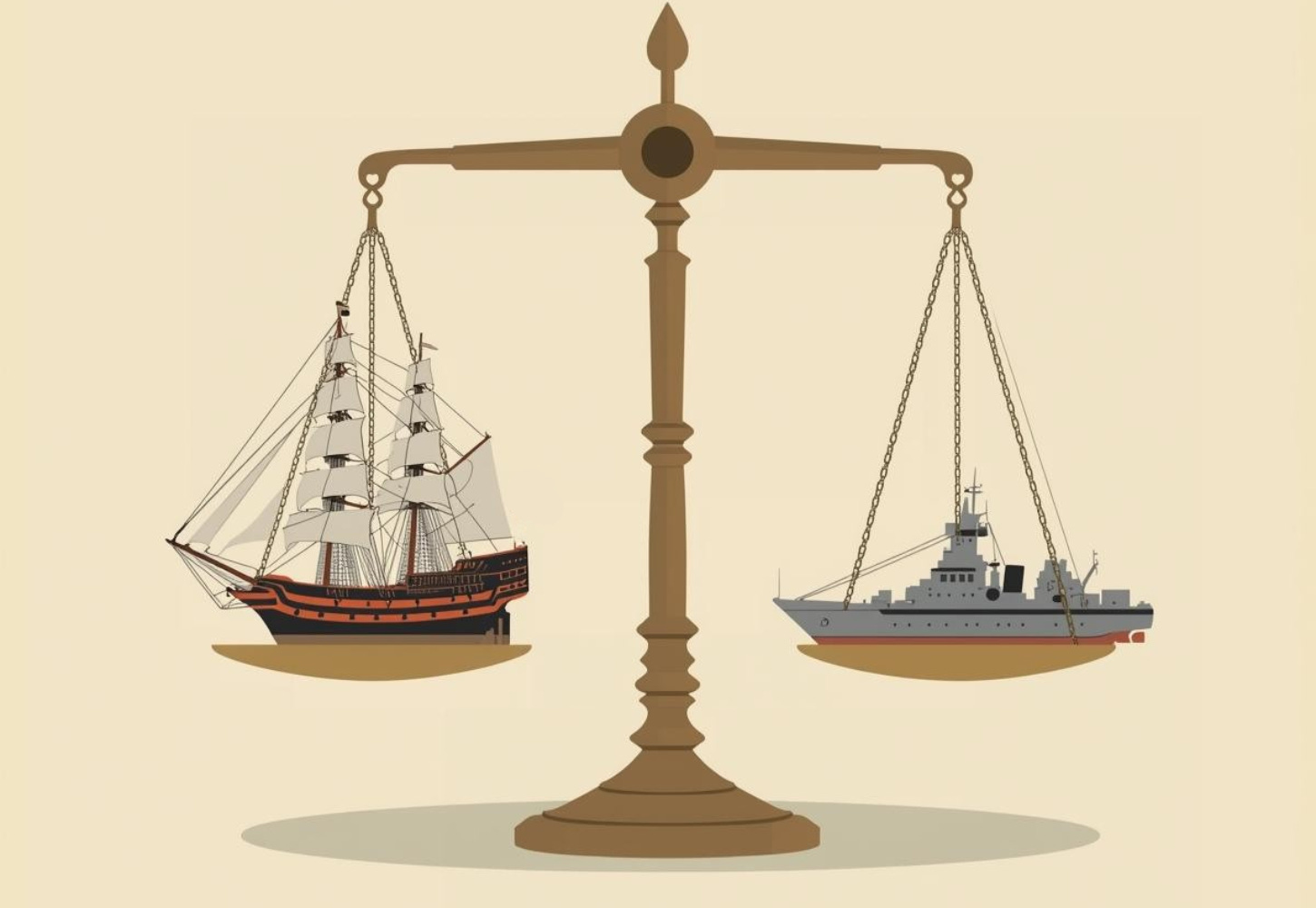
220 years ago, British sea power broke Napoleon’s bid for continental dominance at the Battle of Trafalgar. Against superior numbers, Horatio Nelson secured not just victory, but maritime supremacy. Yet, victory at Trafalgar was not an anomaly; it was the continuation of an enduring strategic tradition – commanding the sea to shape the continent. The true anomaly was that Trafalgar required battle at all.
The United Kingdom’s (UK) historic way of warfare relied less on warfighting and more on deterrence, using economic pressure, agile coalitions and sea power. Crucially, Britain achieved this not through partaking in war, but by avoiding it. This approach eschewed protracted continental entanglements and paralysed adversaries economically, sustaining a balance of power for centuries.
Today, the balance is under threat once again. As the United States (US), the current balancer of the world order, reorients towards the Indo-Pacific, Russia continues its full-scale invasion of Ukraine while conducting sub-threshold attacks across free and open European nations. The UK should resume its historic role, and implement a ‘Balance of Power 2.0’: a modern maritime strategy combining sea power, geoeconomics and flexible coalitions to restore order to its continent.
Continental drift
European nations face their most acute security challenge since the Second World War. Russia’s revanchist ambitions drive a campaign across the full spectrum of conflict. The Strategic Defence Review, published in June 2025, underscores the Kremlin’s willingness to ‘use military force, inflict harm on civilians and threaten the use of nuclear weapons.’ Moreover, Russia’s ‘hybrid’ tactics have brought attacks below the threshold of armed conflict to British soil.
These attacks include disinformation campaigns to corrode democratic resilience, and threatening sabotage to Critical Undersea Infrastructure (CUI) – undersea cables carrying US$10 trillion (£7.46 trillion) of financial transactions daily and energy interconnectors deemed ‘necessary for a country to work.’ Meanwhile, North Atlantic Treaty Organisation (NATO) cohesion is tested by escalating airspace incursions along its eastern flank.
Compounding this is a structural shift: Washington’s pivot to the Indo-Pacific. For 80 years, the US underwrote the European balance of power. Now, as it reorientates eastward, where its economic and security interests are ‘inextricably linked’, its European allies and partners risk strategic drift. At the Munich Security Conference in February 2025, JD Vance, Vice President of the US, captured the American zeitgeist: Europe should be deprioritised in favour of regions ‘in great danger’. This shows a rational calculus for Washington, but one of strategic instability for Europe as a whole. The choice is stark: European nations must restore balance or they risk collapse.
The British way in warfare
Britain’s historic grand strategy was never about ruling Europe; it was about balancing it. For centuries, the UK projected power from the sea to influence the land, combining military, economic and diplomatic levers into a cohesive grand strategy: command the sea, cultivate coalitions and choke belligerents through economic blockade. This design endured because it rested on a distinct synthesis of principles.
First, history proves it works. As Sir Winston Churchill explained:
For 400 years, the foreign policy of England has been to oppose the strongest, most aggressive, most dominating power on the continent…we always took the harder course, joined with the less strong powers, made a combination among them, and thus defeated and frustrated the continental military tyrant.
From the War of the Spanish Succession in the early 18th century to the defeat of Nazi Germany in 1945, Britain prevented every bid for continental supremacy. Time and again it assembled flexible coalitions, aligning with or against the other powers on the European continent. This ability to coalesce smaller powers through flexible alliances was thus never about conquest; it was about preserving Europe’s balance of power.
Second, the UK used geography to amplify strategy. Surrounded by sea, it built a global maritime order predicated on trade rather than force, avoiding protracted conflicts by projecting sea power to dominate maritime chokepoints and impose economic ruin. As Prof. Andrew Lambert notes, few recall the Anglo-Russian War of 1807-1812 because it involved little fighting. Britannia’s rule of the waves drove Russia to the brink of fiscal collapse, compelling Tsar Alexander I to capitulate to the UK’s sea power and choose war with Napoleon rather than economic ruin.
A strong maritime strategy meant that Britain never needed a mass army. Instead, trade revenues subsidised coalitions of smaller powers, which substituted for the lack of a ‘grand armée’. Even in exceptions such as the First World War, sea power remained decisive. Indeed, Sir Basil Liddell-Hart, military historian and theorist, concluded that the blockade of German ports was the ‘most fundamental’ cause of its defeat.
Third, the UK did not privilege sea power over land power. Instead, it combined them. As the doyen of maritime strategy, Sir Julian Corbett, British naval historian and geostrategist, observed that ‘since men live upon the land and not upon the sea, great issues between nations at war have always been decided…by what your army can do.’
The UK created strategic dilemmas by opening unexpected fronts which fractured enemy cohesion, denying the ability to concentrate mass for decisive action. The Duke of Wellington’s Peninsular War campaign exemplified this: the Royal Navy landed 14,000 troops, dividing Napoleon’s Grand Armée to address what the Emperor of the French called his ‘Spanish ulcer’. This ability to prosecute limited campaigns in the continent’s unlimited wars used the sea as a force multiplier. Napoleon himself lamented that an army of 30,000 men could paralyse his army of 300,000 through command of the sea. Indeed, Trafalgar enabled Waterloo: what Nelson started, Wellington finished.
Britain has repeatedly demonstrated that it can shape Europe’s balance of power without succumbing to it. The lesson is clear: the antecedents of the UK’s grand strategy provides a roadmap for the 21st century. Balance of Power 2.0 should adapt these principles to a world of sub-threshold threats, both digital and physical chokepoints, and geoeconomic coercion.
From Nelson to NATO
Balance of Power 2.0 is about deterrence, not dominance. The restoration of British grand strategy does not mean resurrecting Pax Britannica. Times have changed, even if the principles have not. Balance of Power 2.0 modernises maritime grand strategy within a NATO framework. The alliance remains the strongest security architecture to preserve Europe’s stability, but it is an instrument, not a source of power. As alliances require initiative to generate order, the UK should operationalise Balance of Power 2.0 through three lines of effort:
The Americans in: Britain must prove that it is still a security maker, not a taker, enabling US deprioritisation without abandonment. This can be accomplished by using flexible coalitions, such as the Joint Expeditionary Force (JEF), to support NATO and secure Wider North and Baltic maritime chokepoints; safeguarding the Greenland-Iceland-UK (GIUK) gap to protect CUI vital to the British and American economies; burden-sharing proportionally, allowing the US to focus on the Indo-Pacific while providing key enablers to Europe, such as Intelligence, Surveillance and Reconnaissance (ISR), logistics and strategic lift; integrating France into a joint nuclear commitment for shared Deterrence and Defence of the Euro-Atlantic, thus reducing pressure on the US and distributing responsibility among allies; and developing minilateral procurement agreements which link European defence expenditure to American industry, thereby embedding Washington’s strategic commitment to Europe through enduring economic interdependence.
The Germans downstream: As the largest defence spender and economy on the continental mainland, Germany should fill the gap of US retrenchment instead of Russia. This would require securing the Baltic Sea so that Germany’s latent mass deters Russia on NATO’s eastern flank; involving Germany in drone coalition agreements, as only allied manufacturing can mass produce drones at scale to deter Russia; using the JEF and expanded Nordic-Baltic Eight (NB8++) to support Germany’s political direction over Europe while avoiding a new equilibrium of continental power; and brokering a bargain linking German defence spending to American industry, thus maintaining transatlantic integration.
The Russians out: The UK must deny Russia any ability to reconstitute as a counter-balancer. To ensure this, it should use legal, economic and geographic chokepoints to disrupt the Kremlin’s revenues and dismantle its ‘shadow fleet’; lead on sanction development and enforcement against the Russian hydrocarbon sector, as a petrostate cannot survive without oil and gas exports; and accept greater risk – historically, coalitions trusted British leadership because Britain was prepared to act on its word.
Balance restored?
Britain is at an inflection point. American reprioritisation to another theatre is inevitable, but the consequences for European nations are not. Before the US, Europe never had a hegemon. It had the UK. And Britain was never strong enough to balance the continent alone – it needed coalitions.
Trafalgar teaches that command of the sea is the first condition for victory; Waterloo teaches that coalitions achieve it. Today, the same principles apply. The UK’s security begins at sea. If Britain acts now, integrating all levers of power into a cohesive maritime strategy, leveraging geoeconomic power and flexible coalitions, it can restore balance and secure Europe’s future. If it waits, European nations risk fracture. Balance of Power 2.0 is not a choice. It is a necessity.
James Langan is a Royal Air Force (RAF) Officer. Previously, he was a European energy trader, where he developed deep expertise in Russian economics and energy markets.
This article is based on topics explored as part of the Maritime Leaders’ Programme.
To stay up to date with The Broadside, please subscribe or pledge your support!
What do you think about this article? Why not leave a comment below?
Great article. Excellent synthesis of historical British strengths with revised applicability in the modern era.
Extremely inciteful read. Thank you for sharing.