

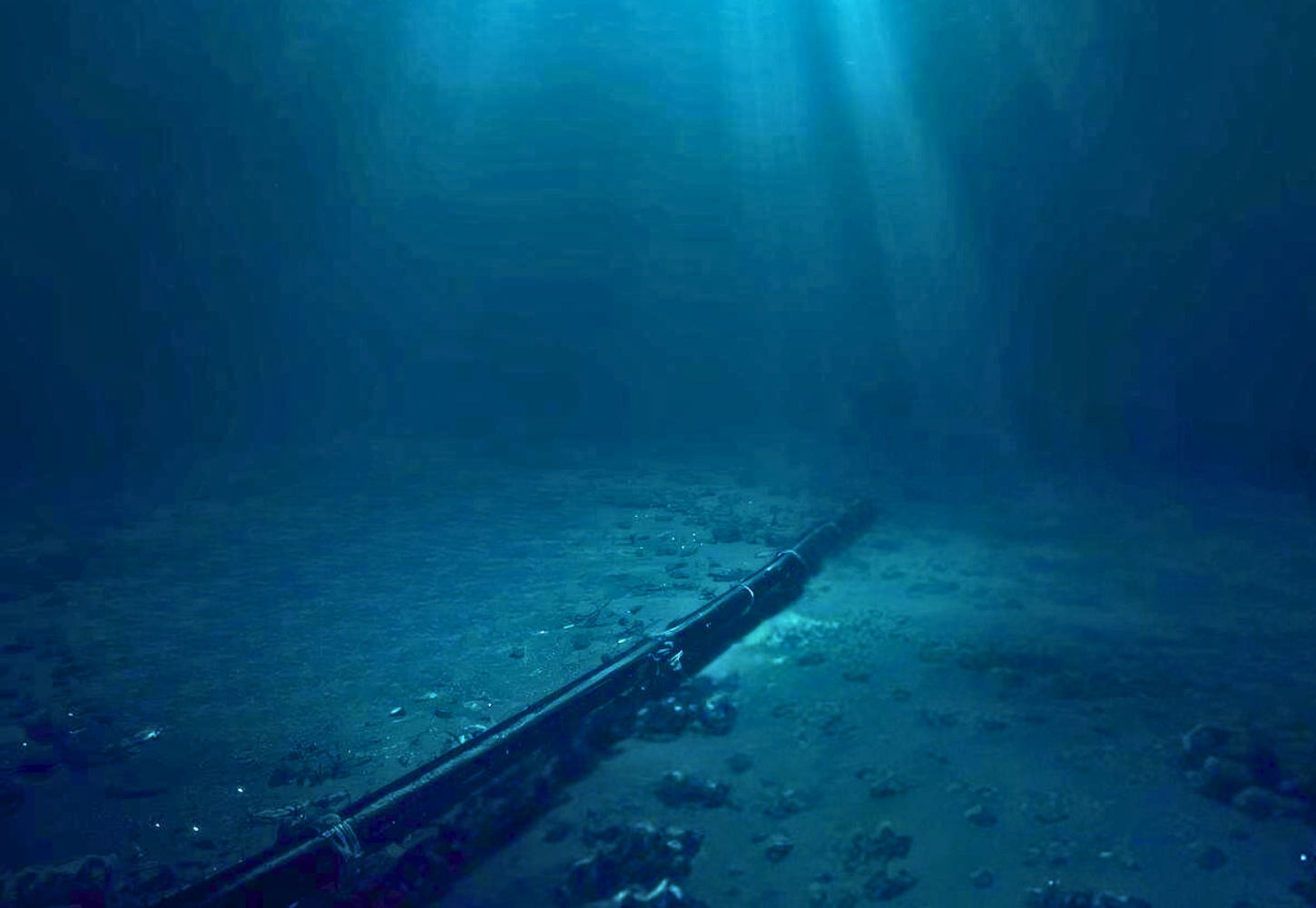
In light of the Yantar – a Russian ‘research vessel’ with a history of loitering near the United Kingdom’s (UK) maritime infrastructure – returning to British waters in late November, it is worth reflecting on the state of the defence of the UK’s undersea Critical National Infrastructure (CNI). Over the last 150 years, undersea CNI has been both a target and a weapon in war. Upon the outbreak of the First World War, for example, British cable ships were sent to divert and cut German cables. Today, as during the First World War, submarine cables are vital to everyday communications and transactions.
There are many similarities between how maritime CNI was defended 100 years ago and how it is defended now. Yet, given how valuable these cables are, modernisation of defence techniques is worthwhile. His Majesty’s (HM) Government’s Strategic Defence Review, published in June 2025, has made it clear that the Royal Navy will ‘play a new leading and coordinating role in securing undersea pipelines, cables and maritime traffic’. With commitments in the Indo-Pacific and the Baltic, however, the Royal Navy is already stretched in capacity. Is Artificial Intelligence (AI) the answer to this Royal Navy capability gap?
As an island nation, the UK is heavily dependent on the undersea cables and infrastructure – about 75% of all gas imports in 2024 were transported via Norwegian pipelines – but at the same time, these are surprisingly vulnerable. AI sceptics are right to warn against expecting it to be a limitless, flawless solution to all defence problems. However, the solution to undersea CNI defence lies partially in large data-processing capacity. In this case, the defence of such CNI would arguably benefit from an AI upgrade.
Surveying British undersea CNI – the approximately 60 cables which connect the UK to the rest of the world – accurately requires the fusion of over 160 million data points per day, collected from sources such as carriers, Automatic Identification Systems (AIS), Global Positioning Systems (GPS), ships, weather updates, ports and terminals. Understanding this data through traditional means is impossible, therefore making Britain reactive to threats. To understand the patterns in behaviours of vessels and maritime actors, the UK Joint Maritime Security Centre has determined it needs 14 year’s worth of these millions of data points. Accurate human understanding and processing capacity of this amount of data is impossible.
AI can process a tremendous amount of data using machine learning. Doing this enables it to learn patterns in maritime data, which can then be used to construct models able to recognise and interpret these data points, and produce analysis about maritime activity. In order to understand the maritime picture better, and to detect threats to Britain’s infrastructure, AI is essential.
Handily, AI-led maritime data fusion is already underway. Research from Thales, a French defence company, suggests that its AI-led Mi-Map sonar analysis application can process sonar data 400% faster than conventional tools. Windward, a maritime AI company, in partnership with software developer Palantir, uses its maritime AI models to interpret data and send direct alerts in response to behavioural analysis and risk detection. The Royal Navy, however, currently does not have the necessary data architecture and networks to process this amount of data, nor to support AI-enhanced processes.
Another issue facing defence of the UK’s CNI is data-gathering capacity. The frontrunner of British CNI surveillance is RFA Proteus, a CNI surveillance ship tasked with surveying the UK’s undersea CNI. RFA Proteus is capable of launching operating Uncrewed Underwater Vehicles (UUVs). However, the task of surveilling the more than 60 CNI cables connected to the UK is a huge task.
In support of surveillance operations, Royal Navy divers also already patrol British undersea CNI. An increase in Remotely Operated Vehicles (ROVs), fitted with onboard AI and able to feed video and sonar data back to operators, would consequently be of great assistance. ROVs developed by the Royal Navy – such as the Defender – are already expected to save lives at sea, as well as prevent adversaries from sabotaging undersea cables and pipelines. Onboard AI would allow for autonomous navigation, improved data processing and analysis, and interoperable and efficient use with valuable Royal Navy personnel.
Getting the UK to become proactive and off the back foot is essential. The North Atlantic Treaty Organisation’s (NATO) Operation BALTIC SENTRY, launched to deter damage to CNI in the Baltic Sea, has already been a major success. To detect and deter damage to the cables landed on the British coast, the use of sensors would arguably act as a huge support to future surveillance operations similar to BALTIC SENTRY.
Placing a ring of AI-enhanced sensors – able to detect the presence of ships and other maritime activity – around the British Isles would further contribute to cheaper and quicker data gathering. The United States (US) has already implemented a similar technology in the Defence Advanced Research Projects Agency’s (DARPA) ‘Ocean of Things’.
With an advanced recognised maritime picture, the Royal Navy can make quicker and more accurate assessments about vessels similar to the Yantar, which have historically threatened undersea CNI, and subsequently recognise and track them, as Windward has demonstrated. Any prevented telecommunication cable damage saves up to £1 million, and prevented energy cable damage avoids footing a bill of over £10 million.
The increase in All-Party Parliamentary Group (APPG) sessions, committees and submitted questions in Parliament relating to concerns about CNI security suggest that politicians are already banging the Corbettian ‘protect the communication lines’ drum. They are right to do so, given there are 150-200 instances of damage to the global network each year. While most damage to undersea infrastructure is accidental, purposeful damage is increasingly common, and is extremely useful as a form of sub-threshold activity by the UK’s adversaries. The Yantar’s return to British waters is a reminder of the very real deep-sea intelligence-gathering submarine-shaped muscles that the Russian Navy and the Main Directorate of Deep-Sea Research (GUGI) are willing and able to flex.
Although AI cannot replace Royal Navy patrol vessels, it has a serious capacity to multiply the effectiveness of undersea CNI surveillance and defence. Those serious about both enhancing the defence of the UK’s infrastructure and protecting the valuable cargo of data, communications, financial services and gas which are transported along this infrastructure, should look to AI to aid the Royal Navy. Adopting AI would provide two primary benefits: firstly by giving the Royal Navy the means to run its own network of AI-led data processing; and secondly, by encouraging investment by HM Government in efficient, low-cost coastal sensors.
Liberty Hunter is a Project Manager and Researcher at the Ax:son Johnson Institute for Statecraft and Diplomacy, and a Research Associate at the Hertford College Diplomacy Centre. She is also a member of the Council on Geostrategy’s Maritime Leaders Programme.
To stay up to date with The Broadside, please subscribe or pledge your support!
What do you think about this article? Why not leave a comment below?
Given that a lot of what is proposed here is fundamentally similar to project CABOT and the Atlantic Bastion concept it would seem insane not to use the same ideas and technology to monitor and protect cables and pipelines.
Prioritising them would seem prudent as well, given Russia is already threatening them, while SSBNs and SSNs are hopefully a long way from being a genuine threat. Demonstrably denying Russia the ability to threaten CNI should have quite the deterrent effect as well...